

Who are the Huron-Wendat
Traditionally, the Huron-Wendat were a great Iroquoian civilization of farmers and fishermen-hunter-gatherers and also the masters of trade and diplomacy. The Huron-Wendat people frequented a vast territory extending into the Gulf of St. Lawrence and up along the St. Lawrence Valley on either side of the river to the Great Lakes. This territory includes the Nionwentsïo, meaning “magnificent territory” in the Huron-Wendat language, which is protected by the 1760 Huron-British Treaty for customary activities such as hunting, fishing, trapping of furbearing animals and harvesting plants. “Huronia”, included in Wendake South, represents part of the Huron-Wendat Nation’s ancestral territory in Ontario. From north to south, this territory extends from Lake Nipissing to Lake Ontario, and from east to west, from Île Perrot to around Owen Sound. More than 800 archaeological sites have been discovered to date, testifying to the significant occupation of the territory by the Huron-Wendat Nation. This invaluable legacy for the Nation is also the most significant archaeological heritage related to a First Nation in Canada.
The “Jean-Baptiste Lainé” site is an eminent part of this heritage. This archaeological site discovered in the 2000s clearly corroborates Huron-Wendat knowledge and culture in terms of its ultimate origins and deepest cultural identity.
Summary kindly provided by the Huron Wendat Nation, Nionwentsïo Office.
Northern Iroquoian Societies
The term “Iroquoian” refers to a shared culture and a linguistic family (with varying dialects) to which the Wendat belong. It is not to be confused with “Iroquois” — an Algonquian word used to refer to the Haudenosaunee Confederacy.
The earliest written descriptions of Northern Iroquoian communities include palisaded settlements with bark-covered longhouses and fully developed maize horticulture supported by hunting, fishing, and gathering.
Labour was divided by gender, the social structure was organized around matrilineal clans, and political organization included village, nation and confederacy councils. At times, there was warfare between nations and/or confederacies.
The Wendat were the northernmost of the Iroquoian societies and their Confederacy consisted of four allied nations: the Attignawantan (Bear), the Attigneenongnahac (Cord), the Arendarhonon (Rock) and the Tahontaenrat (Deer). The name “Wendat” is interpreted as “islanders” or “the people of the peninsula.” Iroquoian peoples referred to the world as “Turtle Island,” which referred to the turtle’s back upon which Sky Woman (“Aateantsic” in Wendat, meaning “Ancient One”) landed in the creation story.
“Wendake” is the term used to describe the ancestral land of the Wendat people. It is traditionally defined as the land between Lake Simcoe, Georgian Bay and Lake Ontario. Wendake is the current name of the home of the Huron-Wendat Nation, located near Québec City.
Huron-Wendat Nation Coat of Arms
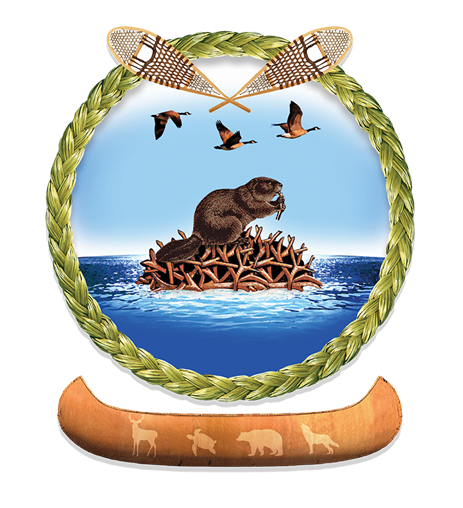
The coat of arms of the Huron-Wendat Nation… represents its culture, territory and history. The geese recall the creation of the world. As Yäa’taenhtsihk fell from the sky world, geese collected her on their wings before placing her on the shell of Great Turtle, the animal chief. Thanks to the land brought from the bottom of the sea by a female toad, Great Turtle became a wonderfully beautiful island, our Earth. This is why our land is known as Turtle Island. The canoe and snowshoes represent the means of transport used for moving across the land and remain an integral part of the economy and craftsmanship of the Huron-Wendat Nation. Water is the source of life and forms the paths to follow between communities. The circle of sweetgrass symbolises the interconnection among all the elements of nature – all life, including humans, animals, plants, spirits, etc., form a whole called Great Circle of Kinship. Sweetgrass itself represents spirituality and has medical value. The symbols on the canoe represent four of the original clans that are present at Wendake today – deer, turtle, bear, and wolf. Finally, the beaver is the national emblem of the Huron-Wendat Nation; it has adapted to many habitats and lives with his family all his life. He is a symbol of endurance, intelligence and pride.
Text by: Ron F. Williamson, PhD.
Text courtesy of Wendat Village Public School, Whitchurch-Stouffville, Ontario.
Understanding Riverine Flooding
Riverine flooding occurs when water from a river or other body of water exceeds its banks, flooding the surrounding area. This is a natural process that happens when high water flow overtops the river channel within a valley system.
Flood Forecasting and Warning
Ontario Conservation Authorities issue flood messages as part of the Flood Forecasting and Warning Program. Local Conservation Authority staff, monitor weather forecasts and watershed conditions on a continuous basis and issue flood messages when conditions warrant, as part of this program.
Stay Informed and Prepared
Use TRCA’s floodplain map viewer to determine if your property is within a river flood-prone area.
Stay updated on current flood conditions and Conservation Authority flood messages.
TRCA provides Digital Flood Handbooks to help residents in flood-prone areas understand and prepare for potential flooding.

111 Sandiford Drive, Stouffville ON, CA
customer.service@townofws.ca
(905) 640-1900

Accessible formats available upon request. Contact 905-640-1900 or customer.service@townofws.ca for assistance.
© 2024 Town of Whitchurch-Stouffville | Privacy and Disclaimer